AI SEO vs Learning SEO Yourself: Why Founders Should Use AI to Assist, Not Automate
- Jun 9
- 8 min read
Updated: Jun 17
By Barry Roodnat, founder of We Optimizz. Wix Legends Partner, Semrush Certified. We've built 894 websites across 35+ countries.
There's a pitch going around that I get asked about almost every week. Connect your site, click a button, and let AI run your SEO. It writes the articles. It builds the backlinks. You go back to running your business.
I understand why it's tempting. I also run an agency, and we use AI every day. Our own app runs on Claude. So this isn't a "stay away from AI" article. It's the opposite. The trouble is specific: it's the fully hands-off version, the part where automation replaces your judgment instead of supporting it. That's where founders get burned, and I've watched it happen.
Below is the honest case for learning SEO yourself, with the evidence behind it. Not the version that sells you a tool. The version I'd give a friend.

Should founders learn SEO, or just automate it with AI?
Learn it, and use AI to help you do it faster. Don't hand the whole thing over.
Google's systems reward content made by people who actually know the subject, and they punish content cranked out at scale to climb rankings, no matter who or what produced it.
When you understand the reasoning behind each step, you can use AI safely. When you don't, you end up triggering the exact patterns Google and the AI search tools are built to filter out. The skill isn't doing the busywork. It's knowing what's worth doing and why. (If you're choosing where to even build that site, our platform comparison guide is a good starting point.)
That's the short version. Here's what's actually happening under the hood.
Does Google penalize AI-generated content?
Not for being AI. It penalizes content made at scale to manipulate rankings without giving people anything useful. Google calls this "scaled content abuse," and the distinction matters more than most tool vendors admit.
In March 2024, Google updated its spam policy to target producing content at scale to boost rankings, whether automation, humans, or a combination are involved. Its own documentation now lists, word for word, using generative AI to generate many pages without adding value for users as an example of abuse. So the line isn't "AI bad, human good." The line is value.
What followed wasn't gentle. Google's stated goal for the update was to cut low-quality, unoriginal content in results by 40%, and it backed that up with manual actions. Sites started getting "Pure Spam" notices in Search Console and vanishing from results overnight, some of them with traffic in the millions. One tracking study of roughly 49,000 sites found 837 of them completely removed from Google's index during the rollout.
Here's the line I keep coming back to:
Google doesn't care how you create content. It cares why you created it.
We've seen the gentler version of this on our own client work. Across 894 sites, the pattern is boringly consistent. Pages where a subject expert reviewed and expanded the draft hold their rankings through core updates. Pages that were AI-first and lightly edited are the ones that wobble. Same tools, different outcome, and the difference is always the human input. (I went deeper on what holds up in this honest breakdown of Framer for SEO, based on real audits.)
Sources: Google Search Central, Spam Policies; The Keyword, Google's official blog; Search Engine Land; Search Engine Journal.
Are automated backlinks bad for SEO?
Yes. Building links with automated software is named, specifically, as link spam in Google's policies. And it doesn't just get ignored. It can drag your site down.
This is the other half of the "automate everything" promise: tools that fire hundreds or thousands of links at your domain while you sleep. It's also one of the oldest tricks in the book, and Google has never been vague about it. The spam policies list generating links through automated programs right alongside buying links and running link exchanges.
Detection has also sped up enormously. A decade ago a bad-link problem might take months to catch up with you. Now Google's SpamBrain system flags suspicious link patterns in close to real time, so manipulative tactics get devalued in a much shorter window. There's also a detail Google was quiet about for years: internal documentation that surfaced in 2024 referenced a signal for bad backlinks, which lines up with what a lot of us suspected.
Spammy links aimed at your site can count against you, not simply get discounted.
And cleanup is miserable. If you pick up a manual action, you're auditing thousands of links, emailing webmasters to get them removed, disavowing the rest, and filing a reconsideration request. Most people badly underestimate how long that takes. The hours and money you'd spend on an auto-link tool, plus the cleanup afterward, would have gone further on content and real outreach that earns links you get to keep.
Automation fails at the exact moment it replaces judgment.
The same logic, by the way, is why the "instant SEO fix" emails landing in your inbox are worth a hard look. We wrote up how the fake-specialist scams actually work, because the shortcuts that promise the most tend to cost the most.
Sources: Google Search Central, Spam Policies; Google Search Console Help, Manual Actions; Ahrefs, Link Spam.
Can AI create E-E-A-T on its own?
No, and this is the part automation can't fake its way around.
E-E-A-T stands for Experience, Expertise, Authoritativeness, and Trustworthiness. It's the framework Google's quality raters use, and it's also a big part of what gets you mentioned by AI search tools. The problem is in the first letter. AI has no experience. It has never used the product, sat in the meeting, or fixed the thing at 2am. When a topic needs real experience, AI can only imitate it by remixing what other people wrote, and Google has gotten good at spotting the imitation.
The other risk gets less attention but worries me more: confident wrong answers. AI will state an outdated stat, misquote a study, or invent a detail that sounds completely plausible. If nobody on your side knows the subject well enough to catch it, it gets published. One bad fact in front of a serious buyer does more damage to your reputation than a missing blog post ever would. In money, health, and legal topics, that's not a small risk.
AI isn't replacing SEO expertise. It's amplifying whatever expertise you bring to it.
The content that actually wins isn't defined by which AI wrote it. It's defined by how a knowledgeable human shaped it: AI for the research, the outline, the blank-page problem; the human for the strategy, the judgment, the angle nobody else has. The technical scaffolding still matters too, which is why we treat things like structured data and schema markup as part of the same job, not an afterthought.
A simple way to use AI without getting burned
After enough client projects, we ended up working in three steps. Nothing fancy, but naming it helps people remember the order:
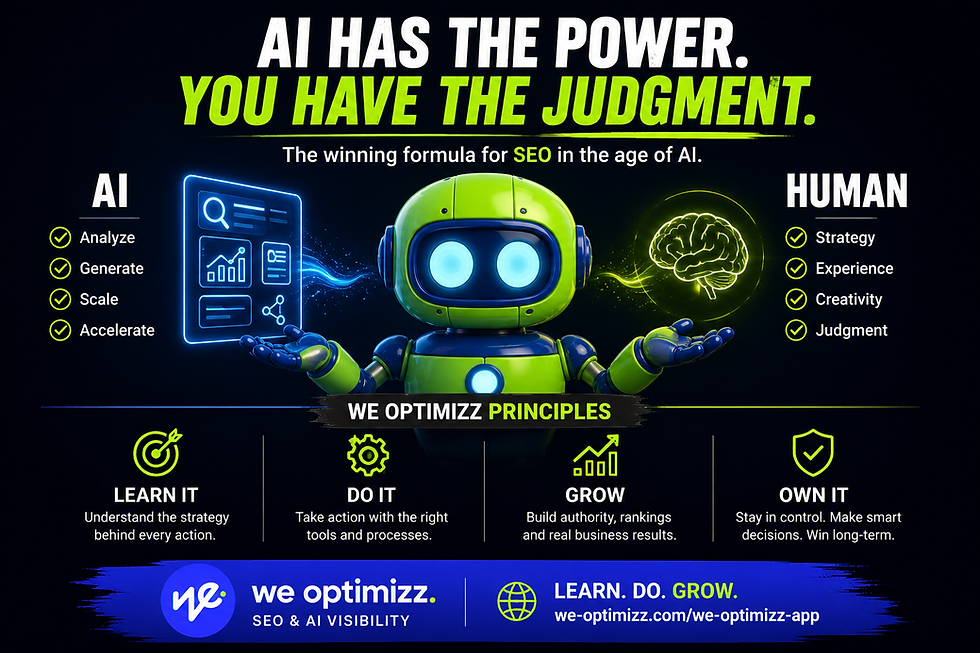
1. Human strategy. Decide what to target and why, before any AI touches it. Keyword, intent, who it's for, what makes your take different. This part is yours.
2. AI acceleration. Now let AI do what it's genuinely good at: research, outlines, first drafts, reformatting, spotting gaps. Speed lives here.
3. Human validation. Fact-check every claim, add real experience the model couldn't have, and make sure the page actually deserves to exist. Nothing publishes until a person who knows the topic has signed off.
If the third step is missing, you don't have an SEO strategy. You have a liability that scales. The same order applies to the technical side: get the internal linking and on-page SEO foundations right first, then let AI help you fill them in.
That third step is exactly why I built the We Optimizz app. Most SEO tools hand you a checklist and hide the reasoning. This one is built around three ideas instead: learn why each element matters, know when to revisit it, and do it yourself with built-in tools for meta tags, schema, internal links, and AI-citation content. It's organised as chapters, so you start with the basics and build up, and each chapter pairs the explanation with the tool that does the job.
It's not built for an agency juggling 50 clients. It's for a founder growing one site who wants to understand the work, not rent it. And yes, it runs on Claude, which is rather the point. The AI is there to teach and assist a person who stays in charge, not to spray content into the void on autopilot.
You can start free, no card needed. Paid tiers run from Starter at €19/mo up through Growth (€39), Scale (€79), and Pro (€129).
What is GEO, and why it's coming for the same shortcuts
GEO stands for Generative Engine Optimization. In plain terms: optimizing your content so AI tools like ChatGPT, Gemini, Claude, Perplexity, and Google's AI Overviews reference your site when they answer someone's question.
This isn't a prediction anymore. Plenty of your customers already ask an AI assistant before they ever open Google, and those tools don't show ten links. They write one answer and credit a few sources. If you're not among them, you're far less likely to be part of the conversation.
Here's the part that ties this whole article together. The things that get you cited by an AI engine are roughly the things that survive a Google update: a recognizable track record, consistent mentions of your business across the web, clearly defined products and people, structured data, and genuine expertise. Same signals. Which means the founder who understands their SEO tends to get rewarded twice, while the one who automated it away gets passed over in both places. If you want the deeper version of this, our full SEO and GEO service breakdown walks through how the two fit together.
Frequently asked questions
Can Google detect AI content? Its systems, including SpamBrain, are built to spot content mass-produced to manipulate rankings, whether a machine or a person made it. But Google's stated position is that it isn't hunting AI content specifically. It's targeting content with no value for the reader. The detectable problem is thin, unoriginal pages at scale, not the tool that made them.
Does Google penalize AI-generated content? Not for being AI. It penalizes scaled content abuse: many pages built mainly to game rankings rather than help people. AI used to support original, expert content is explicitly fine. AI used to flood your site with filler is what earns demotions and, in bad cases, manual deindexing.
Are automated backlinks safe? No. Generating links with automated programs is listed as link spam in Google's own policies. With fast detection through SpamBrain, automated schemes get devalued quickly, and low-quality links pointed at your site can count against you rather than simply being ignored.
Are backlinks still important in 2026? Yes, the earned kind. Relevant editorial links from real sites still help. Bought, networked, or auto-generated links create long-term risk. Earned versus manufactured is the whole distinction.
What is GEO? Generative Engine Optimization: shaping your content so AI tools like ChatGPT, Gemini, Claude, Perplexity, and Google AI Overviews cite your site in their answers. It leans on structured data, clear entities, real expertise, and consistent brand mentions.
Can AI tools improve my SEO? Yes, as an assistant. AI is great for research, outlines, drafts, and data work. It's poor at first-hand experience, original insight, checking its own facts, and strategic calls. A human has to bring those, or the content won't rank or get cited.
Should founders learn SEO themselves? For most, yes. Understanding the reasoning lets you use AI safely, catch its mistakes, and build visibility that lasts, instead of handing your growth to automation that the search engines keep filtering out. A good first step is setting up your blog for SEO properly before you publish anything.
The bottom line
AI belongs in your SEO. I'd say it's essential now. But "AI does my SEO automatically" and "I use AI to do my SEO better" are two very different bets, and Google, Perplexity, and ChatGPT have all made it clear which one they back.
Learn it, do it, grow. With how fast the shortcuts get caught these days, that's not the slow road. It's the quick one.
Written by Barry Roodnat, Wix Legends Partner, Semrush Certified, and founder of We Optimizz in Hasselt, Belgium. Want a human to look at your specific site? Get a free visibility scan.


Comments