


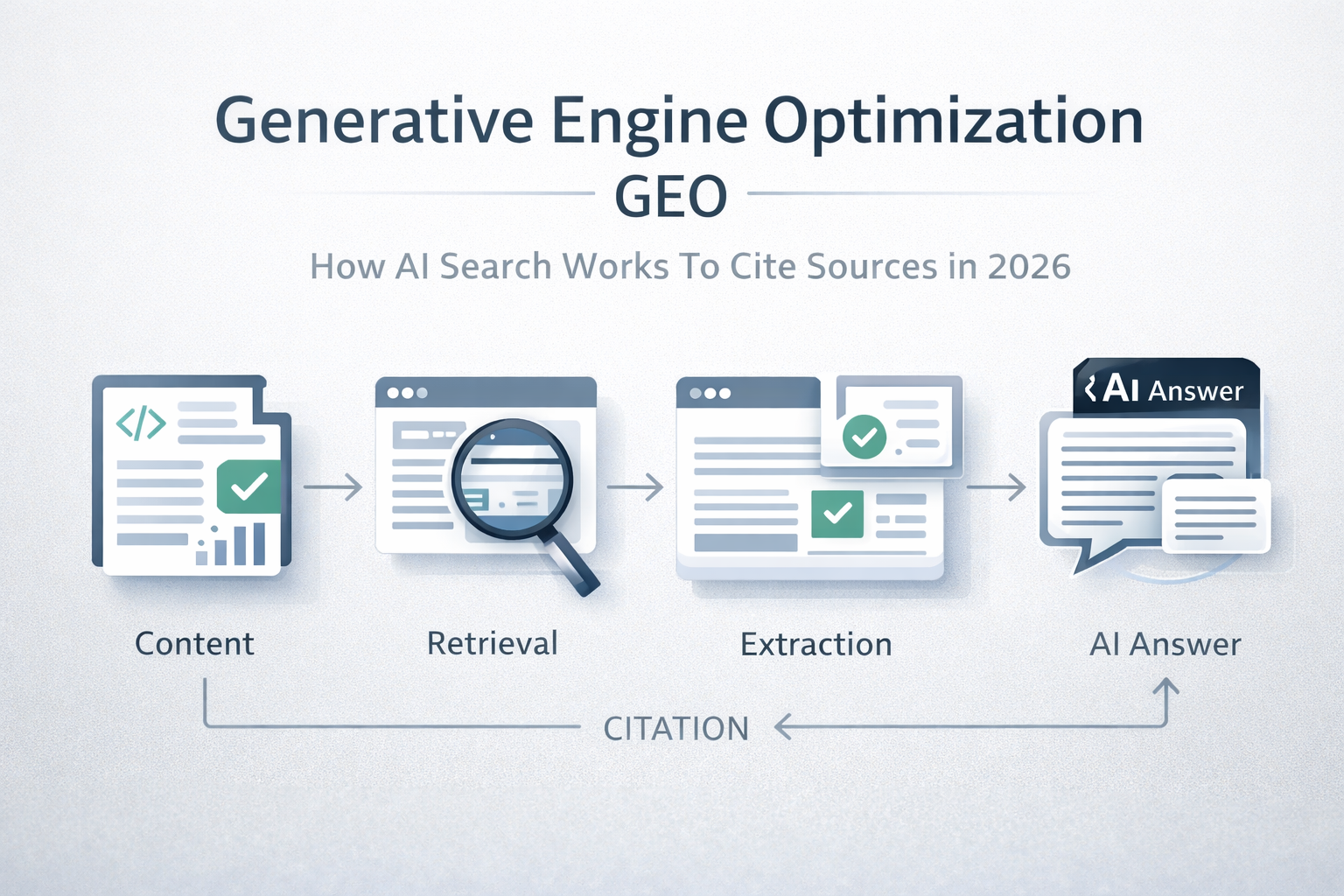
Generative Engine Optimization (GEO) is the practice of making your content easier for AI search systems to find, trust, and cite in generated answers.
It matters because a growing share of users now get their answers directly from tools like Google AI Overviews, ChatGPT and Perplexity - without clicking through a list of links. If your content is not what those systems choose to surface, your business does not appear in that interaction, regardless of where you rank in traditional search.
SEO gets you ranked. GEO helps you get cited.
In this guide you will learn what GEO means, how it differs from SEO, which signals AI systems use to select sources, and where to start improving your AI search visibility in 2026.
What Does GEO Stand For?
GEO stands for Generative Engine Optimization.
The term was formalized in a 2023 arXiv paper later published in the KDD 2024 proceedings by researchers affiliated with Princeton University, Georgia Tech, The Allen Institute for AI, and IIT Delhi. The paper introduced GEO as a framework for optimizing web content specifically for retrieval and citation by large language model (LLM)-based search systems, and reported visibility uplifts of up to 40% in controlled benchmarks when GEO principles were applied.
The core idea: AI search engines do not simply retrieve pages and return a list. They read, process and synthesize content from multiple sources - then generate a single answer. GEO is the discipline of making sure your content is what those systems choose to include.
What Is a Generative Engine?
A generative engine is any search tool that uses a large language model to produce a direct answer - rather than a ranked list of links. Google AI Overviews, ChatGPT Search, Perplexity AI, Microsoft Copilot and Gemini Advanced all work this way.
What they share: each platform evaluates which content is credible and relevant enough to include in a generated answer. That selection decision is what GEO is designed to influence.
GEO vs SEO: What Is the Difference?
GEO and SEO optimize for different outputs.
Traditional SEO gets your content to rank in a list of search results. Success is measured by position.
GEO gets your content cited inside AI-generated answers. Success is measured by citation frequency - how often your content appears when AI tools answer questions relevant to your business.
GEO does not replace SEO. Traditional SEO remains the foundation - a page that is not indexed cannot be cited by AI. But content that is easier to extract, verify and synthesize tends to be cited more frequently in AI-generated experiences.
For a full breakdown, read: GEO vs SEO: Key Differences Explained.
Dimension | SEO | GEO |
Target system | Google Search index | AI language models |
Output format | Ranked list of links | Generated answer with citations |
Success metric | Ranking position | Citation frequency |
Content focus | Keyword targeting | Authority, clarity, structure |
Key signals | Backlinks, page speed | E-E-A-T, credibility, extractability |
Update cycle | Algorithm updates | Model retrieval logic |
Why GEO Matters in 2026
The shift is happening now - and the data makes it concrete.
Google has stated that AI Overviews appear for hundreds of millions of queries per day. A 2024 study by SparkToro and Datos found that approximately 59.7% of Google searches in the EU and 58.5% in the US ended without a click - users got their answer directly from the results page.
This does not mean organic traffic is dead. But for informational queries - where businesses historically built top-of-funnel awareness - AI features are increasingly answering the question before the user clicks anywhere.
Meanwhile, OpenAI positions ChatGPT Search as live web search with inline citations to source pages. Perplexity surfaces a small number of attributed sources per answer. Businesses that appear as those cited sources gain visibility within the answer experience itself. Those that do not are absent from the interaction entirely.
GEO is how you compete in this environment.
What GEO Is Not
A few common misconceptions worth clearing up before going further.
GEO is not a replacement for SEO.
Indexability, page speed, quality content and internal linking remain the prerequisite for any GEO strategy. If your pages are not indexed, AI systems cannot retrieve them.
GEO is not just adding schema markup.
Structured data helps search engines interpret your content more consistently, but it is not a special requirement for appearing in AI features. Google's own guidance states that the same fundamental SEO best practices apply to AI-powered results, and that no additional technical requirements exist specifically for those features.
GEO is not publishing AI-written summaries.
Content produced entirely by AI without expert review, original data or genuine first-person perspective scores poorly on the authority and trust signals that influence AI citation. Writing for AI systems means writing with more credibility, not less.
GEO is not a guaranteed citation placement.
There is no mechanism that ensures your page is cited. GEO improves the probability that well-structured, credible, relevant content is selected - but citation decisions remain within each platform's own retrieval logic.
How AI Search Engines Choose Which Sources to Cite
Each platform has its own architecture, but the general selection process follows a recognizable pattern:
Retrieval:
The system queries an index to identify candidate pages relevant to the query.
Relevance scoring:
Candidate pages are scored for how directly and clearly they address the question. Pages that open with a direct answer tend to score higher.
Authority and trust evaluation:
The system assesses source credibility - domain authority, author credentials, whether claims are supported by named sources, whether the content has been cited by other trusted pages.
Passage extraction:
The system extracts the most useful passage from the page, not the entire page. How individual sections are written matters as much as overall page quality.
Synthesis:
Extracted passages from multiple sources are combined into a single answer. Content that provides a precise response to a specific question is most likely to survive this step.
In practice, this means a well-written 60-word paragraph answering a specific question can outperform a 2,000-word page that never directly addresses it.
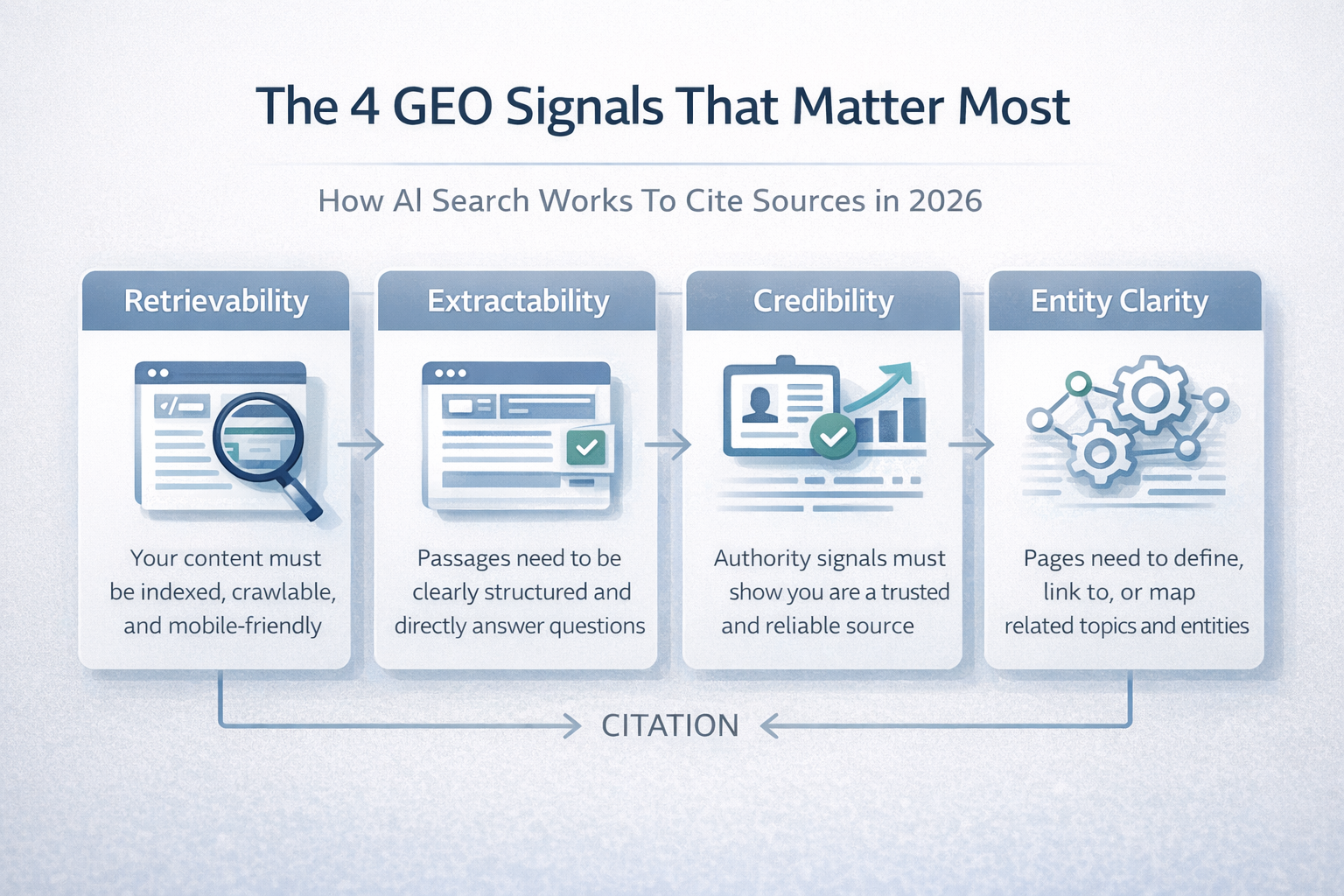
The 4 GEO Signals That Matter Most
Based on the KDD 2024 research and consistent patterns observed in client work, four signals have the most practical impact on AI citation likelihood.
1. Retrievability
Your content must be discoverable before it can be cited. This means full indexability, clean URL structure, mobile optimization, and crawlability by both standard and AI-specific crawlers. Without retrievability, the other three signals are irrelevant.
2. Extractability
AI systems cite passages, not pages. A page with strong overall authority but poorly structured individual sections will lose citation opportunities to a weaker page whose sections are clearly written and directly answering questions.
Write each section as though its opening paragraph will be extracted and read in isolation - because that is often exactly what happens.
3. Credibility
AI systems apply trust signals to content before deciding to cite it. Credibility is demonstrated through: named authorship with verifiable credentials, claims supported by attributed data, first-person experience rather than generic opinion, and consistency with what other trusted sources say about the topic.
In our client work, pages with explicit author bios, real case observations and sourced statistics consistently outperform similar pages without them in AI citation tests.
4. Entity clarity
AI knowledge models are organized around entities - concepts, people, organizations, products. Pages that clearly define what they are about, and connect that topic to related entities through structured internal linking, are easier for AI systems to categorize and reference.
This is why pillar-cluster site architecture is not just an SEO strategy - it is a GEO signal. A well-linked cluster tells AI systems that your domain has established, connected expertise on a topic.
Applying the 4 Signals: Passage Design in Practice
The extractability signal deserves a concrete example, because it is the one most commonly neglected.
Weak passage - low citation likelihood:
"GEO is a concept that has been discussed a lot lately in the SEO world. There are many different ways to think about it, and experts have different opinions on what it means in practice."
AI-citable passage - high citation likelihood:
"GEO (Generative Engine Optimization) is the practice of structuring content so AI search systems can identify, extract and cite it in generated answers. The core requirement is directness: a clear answer to a specific question, supported by evidence, written in accessible language."
The difference is not length - it is structure and directness. The second passage opens with a definition, names the concept, and closes with a specific, extractable principle. An AI system can use it. The first one cannot be meaningfully cited.
Apply this principle to the first paragraph of every section on your key pages.
GEO for Specific Platforms
The 4 signals above apply across all generative engines, but each platform has specific characteristics.
Google AI Overviews
pull from pages already in Google's index. Standard SEO fundamentals - indexability, page speed, mobile optimization - are the non-negotiable entry requirement.
Read: How to Optimize for Google AI Overviews
ChatGPT Search
retrieves live web content and cites it inline. It favors pages with clean structure, clear definitions and domain authority signals.
Read: How to Get Found in ChatGPT
Perplexity AI
cites more sources per answer than most AI tools and is particularly active in surfacing recent content and niche expert sources - making it one of the most accessible entry points for businesses starting with GEO.
Read: How to Get Cited by Perplexity
Common GEO Mistakes to Avoid
Mistake | Why It Hurts GEO |
AI-generated content without expert review | Weakens E-E-A-T and source credibility signals |
Vague or unsupported claims | AI systems favor verifiable, attributed facts |
Poor heading structure | Reduces passage extractability |
No author information | Weakens trust signals |
Keyword stuffing instead of answering questions | AI systems evaluate answer quality, not keyword density |
Treating schema as the primary GEO lever | Schema supports clarity but does not override content quality |
If a page reads as though it was written to satisfy a keyword list rather than genuinely answer a question, AI retrieval systems are increasingly able to detect that pattern.
Read: Why AI-Written Content Doesn't Rank.
How to Measure GEO Performance
GEO measurement is still evolving. No single dashboard shows citation frequency across all AI platforms.
Manual testing remains the most direct method: query AI tools with questions your business should answer, and check whether your content is cited. Build this into a monthly routine across Google, ChatGPT and Perplexity.
Google Search Console provides useful proxy signals: Google has confirmed that clicks from AI features are tracked within standard Search Console Web results. Monitor impression growth on informational queries, and watch for CTR shifts on pages where AI Overviews are active.
Third-party tools including SE Ranking and Semrush are actively developing AI visibility tracking features.
Engagement signals on AI-exposed pages - time on page, scroll depth, conversion rate - indicate whether AI-referred traffic is genuinely qualified.
For a step-by-step tracking approach, read: How to Check Your AI Search Visibility.
Where to Start This Week
If you want to act on GEO now without rebuilding your entire content strategy, start here:
1. Run a visibility test.
Pick your five most important informational queries. Enter each into Google, ChatGPT and Perplexity. Note which sources are cited. Is your website among them?
2. Rewrite your section openings.
On your three most important pages, rewrite the first paragraph after each H2 heading to be a direct, 40–80 word answer to the question that heading implies. This single change improves extractability immediately.
3. Add or verify structured data.
Ensure Article, FAQPage and BreadcrumbList schema are present and match your visible content on key pages.
These three actions address the highest-impact GEO signals with the least effort. Everything else - deeper E-E-A-T signals, internal linking refinement, platform-specific optimization - builds on this foundation.
Summary: What Is GEO?
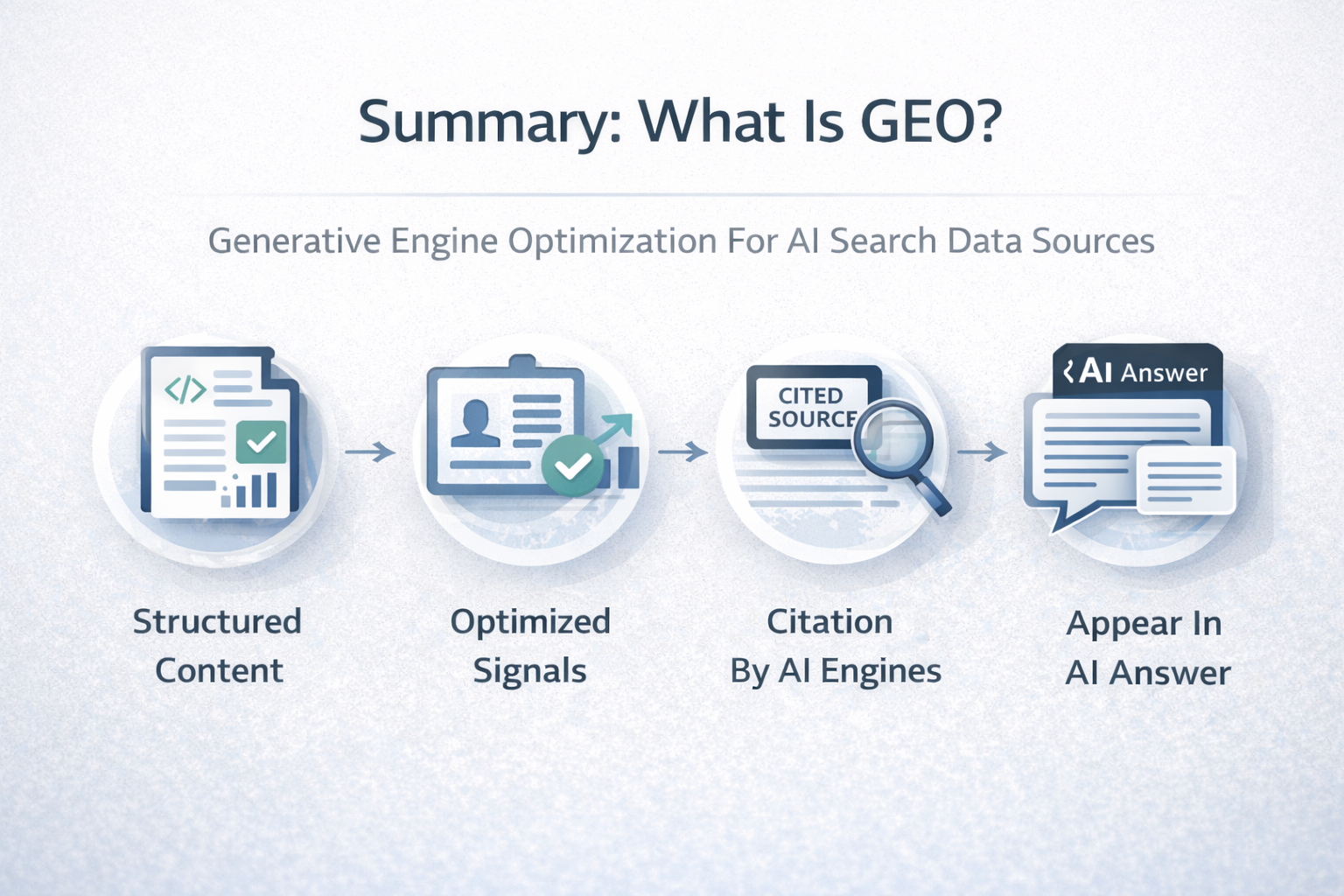
GEO - Generative Engine Optimization - is the practice of making your content easier for AI search systems to find, trust, and cite.
It builds on traditional SEO fundamentals and extends them with four signals that specifically influence AI citation: retrievability, extractability, credibility, and entity clarity.
As AI-powered tools handle a larger share of informational search queries, appearing in generated answers is becoming as strategically important as ranking in traditional search results.
FAQ
What does GEO stand for?
GEO stands for Generative Engine Optimization - the practice of optimizing content to be cited in AI-generated answers from tools like Google AI Overviews, ChatGPT and Perplexity.
What is the difference between SEO and GEO?
SEO helps pages rank in search results. GEO helps brands get cited in AI-generated answers. Traditional SEO is the foundation - without indexability and page quality, GEO cannot function. Content that is well-structured, credible and easy to extract tends to perform better in AI citation as well.
Is GEO the same as AEO?
GEO (Generative Engine Optimization) and AEO (Answer Engine Optimization) describe closely related practices. GEO is the more technically precise term, grounded in academic research published in KDD 2024, while AEO is a broader marketing term often used interchangeably.
Do I need special schema markup for GEO?
Structured data helps AI systems interpret your content more consistently, but Google has confirmed that no additional technical requirements exist specifically for AI features. Schema reduces ambiguity - it does not replace content quality or override the other GEO signals.
Does GEO work for small businesses?
Yes. AI citation is determined by content quality, structure and credibility - not budget. Small businesses with well-structured, expert content can appear in AI-generated answers ahead of larger, less-optimized competitors.
How long does it take to see GEO results?
Citation timing varies by platform, crawl status and query type. Some AI systems surface newly indexed content quickly. Building consistent citation authority across multiple platforms typically takes several months of ongoing optimization and monitoring.
Which platforms does GEO apply to?
GEO applies to any AI system that generates answers using web content - including Google AI Overviews, ChatGPT Search, Perplexity AI, Microsoft Copilot and Gemini. Each has different retrieval logic, but the core signals of retrievability, extractability, credibility and entity clarity apply across all of them.
About the Author
Barry Roodnat Founder & SEO Strategist - We Optimizz Semrush Certified SEO Specialist | Wix Legend Partner | Wix Developer Award
Barry is the founder of We Optimizz, an international web design and SEO agency based in Belgium. With 10+ years of experience and 870+ websites built across 35+ countries, he specializes in Wix Studio development, technical SEO and Generative Engine Optimization.
He holds certifications from Semrush, Wix (WebDev, Accessibility) and has led SEO projects resulting in measurable indexation improvements - including a case study where orphan pages were reduced from 19 to 2 and indexed pages grew from 44% to 91% within 8 weeks.
At We Optimizz, Barry combines traditional SEO fundamentals with emerging GEO strategies to help businesses improve visibility across both classic search and AI-powered platforms like Google AI Overviews, ChatGPT and Perplexity.